A cleanroom class is not a design preference or a marketing label. It is a measurable limit on airborne particle concentration, verified under defined conditions. This ISO 14644 cleanroom classification guide explains how those limits are set, what they mean for facility design and how to maintain confidence in performance after handover.
For pharmaceutical, biotechnology, medical device, aerospace, electronics and research facilities, the classification decision has commercial as well as technical consequences. Specifying a class that is too low can introduce contamination risk, product-quality concerns and compliance exposure. Specifying a class that is unnecessarily high can increase capital cost, energy demand, maintenance requirements and operational complexity for the life of the facility.
What ISO 14644 cleanroom classification means
ISO 14644 is the internationally recognised family of standards for cleanrooms and associated controlled environments. Part 1, ISO 14644-1, defines the classification of air cleanliness by particle concentration. It assigns an ISO Class from 1 to 9, with ISO Class 1 representing the most stringent airborne particulate control and ISO Class 9 the least stringent within the standard.
The classification is based on the maximum permitted concentration of airborne particles at specified particle sizes in one cubic metre of air. The lower the ISO Class number, the fewer particles may be present. This is why a higher-performance cleanroom requires more carefully engineered airflow, filtration, pressure control, finishes, cleaning procedures and personnel practices.
ISO 14644-1 addresses non-viable particles. It does not, on its own, set microbiological limits or prove that a space is suitable for sterile manufacture. Where viable contamination control or medicinal-product manufacture is involved, ISO requirements must be considered alongside the relevant GMP expectations, risk assessment and process needs.
The ISO classes in practical terms
Particle limits are calculated across a range of particle sizes. The figures below illustrate commonly specified limits for particles at or above 0.5 µm and 5.0 µm. Concentrations are expressed as particles per cubic metre.
| ISO class |
Maximum particles at ≥0.5 µm/m³ |
Maximum particles at ≥5.0 µm/m³ |
| ISO 5 |
3,520 |
29 |
| ISO 6 |
35,200 |
293 |
| ISO 7 |
352,000 |
2,930 |
| ISO 8 |
3,520,000 |
29,300 |
ISO Classes 1 to 4 are used for exceptionally stringent applications and require specialist engineering. ISO 9 broadly represents the particle concentration in a typical indoor room, although actual conditions will vary significantly. In many UK projects, ISO 5 to ISO 8 are the central design range, but the right answer depends on the work being undertaken, not on a generic sector label.
For example, an ISO 7 background area may support controlled assembly or preparation activity, while localised ISO 5 unidirectional airflow protection is used at a critical open-product point. Conversely, a laboratory handling sensitive samples may need a different approach to pressure cascades, containment and air-change strategy than a medical device assembly suite with a similar particle-classification target.
Classification is only one part of contamination control
A compliant particle count does not automatically mean a facility is fit for purpose. Air cleanliness must work alongside the full contamination-control strategy: airflow direction, HEPA or ULPA filtration where required, room recovery, temperature and humidity control, pressure differentials, materials and personnel flows, cleaning regimes and maintenance access.
This distinction matters particularly where the process creates its own contamination risk. A high particle count generated by people, packaging or equipment may be addressed through layout, operating discipline and local extraction rather than simply increasing the room-wide classification. Equally, a cleanroom designed solely around particle limits may fail to provide the containment, environmental stability or ergonomic workflow needed by the operation.
At rest, operational and the purpose of the room
ISO 14644-1 recognises three occupancy states: as built, at rest and operational. These terms describe the condition of the room during testing and must be agreed before a classification programme is planned.
As built means the facility is complete, services are operating and installed equipment is in place, but there are no personnel present.
At rest means the installation is complete, equipment is operating in the agreed manner and personnel are absent.
Operational means the cleanroom is functioning in its defined operating mode with the agreed number of people working to documented procedures.
The selected state must reflect the way the space will actually be controlled. Testing only at rest may be appropriate for some applications, but it will not demonstrate how a room responds to personnel activity. Operational classification can be more demanding to plan because the process, staff numbers, gowning, equipment configuration and test timing all need to be representative and controlled.
For GMP environments, the relationship between ISO classification and cleanroom grades should be assessed carefully. They are related but not interchangeable. GMP introduces additional requirements around microbial control, process risk and qualification, including differing expectations for at-rest and in-operation conditions.
How ISO 14644-1 classification testing is carried out
Classification is performed using calibrated airborne particle counters and a documented sampling plan. The standard defines the minimum number of sample locations according to the cleanroom area, as well as requirements for sample volume and interpretation of results.
In simple terms, representative samples are taken across the room, including locations that reflect the intended risk profile. A test engineer will consider critical work zones, supply air patterns, door interfaces, equipment positions and areas where personnel activity may influence airflow. The objective is not simply to find the cleanest point in the room, but to demonstrate that the whole classified space meets its required limits.
The particle counter must be suitable for the particle sizes being measured and maintained under an appropriate calibration regime. Test records should clearly identify the room, occupancy state, particle sizes, sample locations, sample volumes, equipment used, results and any deviations. These records form part of the documented evidence needed for quality assurance, customer audits and regulatory inspection.
A classification result should also be read in context. A failed result may point to filter integrity, airflow balance, pressure control, installation cleanliness, poor recovery after door opening or process-related particle generation. Retesting without identifying the cause can waste time and leave an underlying performance issue unresolved.
Design decisions that determine whether a room can achieve class
The cleanroom class should be established during the user requirement specification stage, before layout and engineering choices become fixed. It should describe the required ISO Class, occupancy state, particle sizes, critical activities, operating hours, process equipment and future capacity expectations.
From there, the engineering solution can be proportionate. Higher classes generally require higher air volumes, more filtration coverage and closer control of room leakage and airflow patterns. That adds energy use and may constrain ceiling coordination, access routes and plant space. A
modular cleanroom can offer speed and future reconfiguration, while a fully bespoke installation may be better suited to complex interfaces, unusual dimensions or stringent performance requirements.
The pressure cascade needs equal care. Positive pressure protects a cleaner space from ingress from adjacent lower-classified areas. Negative pressure may be necessary where containment of hazardous materials takes priority. These objectives can conflict, so the pressure strategy must be developed around the process risk assessment rather than assumed from the ISO Class alone.
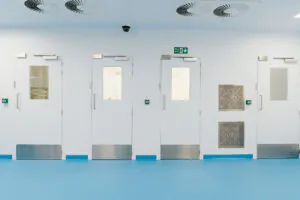
Finishes, coving, doors, glazing and service penetrations also affect cleanability and leakage control. Details that appear minor on a drawing can have a material effect on commissioning time, recoverability and the ease of keeping the facility compliant years later.
Classification, commissioning and ongoing verification
A cleanroom should not be treated as complete when construction ends. Commissioning establishes that systems operate as designed. Validation then provides documented evidence that the installed facility meets the agreed performance requirements, including classification where applicable.
Other tests may be required to support the overall qualification package, such as HEPA filter integrity testing, airflow volume and velocity measurement, air-change assessment, pressure differential testing, airflow visualisation, temperature and humidity mapping, recovery testing and containment assessment. The correct programme depends on the facility, classification and regulatory context.
ISO 14644-2 sets expectations for a monitoring plan that demonstrates continued cleanroom performance. This is where lifecycle planning becomes essential. Filters age, doors are adjusted, layouts change, equipment is introduced and operating practices drift. Periodic requalification, planned maintenance and meaningful
environmental monitoring provide early warning before a minor issue becomes an operational interruption.
Total Clean Air combines cleanroom design, construction, commissioning and
UKAS ISO 17025-accredited validation to help clients carry that accountability from early specification through to reliable ongoing performance.
How often should a cleanroom be reclassified?
The frequency should be defined through risk assessment, applicable regulations, customer requirements and the monitoring plan. Reclassification may also be required after significant changes, such as major maintenance, filter replacement, alterations to airflow systems, room modifications or changes to the process and occupancy pattern.
Is ISO Class 7 cleaner than ISO Class 8?
Yes. ISO Class 7 permits fewer airborne particles than ISO Class 8, so it is the more stringent classification. Whether it is the appropriate choice depends on the product, process and contamination risks, not simply a desire for the lowest possible particle count.
Can one facility contain several ISO classes?
Yes. Many facilities use a graded arrangement, with different classifications for corridors, support rooms, preparation areas and critical processing zones. This approach can protect the highest-risk activity while avoiding the cost and energy burden of applying the same stringent class across the entire footprint.
The most dependable starting point is a clear definition of what must be protected, what can generate contamination and how the team will use the space every day. With that evidence in place, ISO classification becomes a controlled engineering decision rather than an expensive assumption.