A
pharmaceutical cleanroom can meet a particle classification on the day of testing and still create an unacceptable contamination risk in routine production. That distinction sits at the centre of GMP cleanroom requirements for pharmaceuticals: compliance is not simply a room specification. It is a controlled, documented system that protects the product through design, operation, monitoring and ongoing maintenance.
For sterile medicinal products, the expectations are particularly exacting. The facility, process, people and quality system must work together to prevent microbial, particulate and pyrogen contamination. For non-sterile products, the risk profile may differ, but the requirement remains the same: the environment must be demonstrably suitable for the product and process it supports.
GMP cleanroom requirements for pharmaceuticals: the starting point
The starting point is a formal quality risk management process. Before selecting a cleanroom classification, air handling system or modular format, the project team should understand what can contaminate the product, where that contamination could arise and how it will be controlled.
This assessment should consider the dosage form, open handling steps, sterilisation method, exposed product contact surfaces, operator interventions, material transfers and the potential for cross-contamination. A facility producing terminally sterilised vials has different environmental needs from one undertaking aseptic filling, while potent compounds and sensitising materials may require containment measures that are not addressed by cleanliness alone.
For sterile manufacture, the contamination control strategy, often shortened to CCS, is the central document connecting these decisions. It should explain how the manufacturer controls contamination across the full process, including premises, equipment, utilities, personnel, cleaning, environmental monitoring, validation and investigation of deviations. A cleanroom design is therefore not an isolated capital project. It is physical evidence of a wider pharmaceutical quality system.
Grades, classifications and what they mean in practice
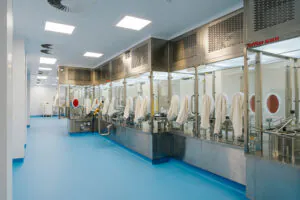
Pharmaceutical cleanroom grades are typically aligned with the principles set out in GMP guidance, including Annex 1 for the manufacture of sterile medicinal products. Grade A is used for the highest-risk critical zones, such as filling points, open vials and aseptic connections. It is commonly achieved with unidirectional airflow or isolator technology.
Grade B provides the background environment for Grade A aseptic preparation and filling where a conventional cleanroom approach is used. Grades C and D support less critical stages, with the required level determined by the process and contamination risk.
These GMP grades should not be treated as interchangeable with ISO 14644-1 particle classes. ISO classification is a defined test of airborne particle concentration. GMP grades include wider operational expectations, such as microbiological control, airflow visualisation, gowning discipline, pressure differentials and a documented contamination control strategy. ISO 14644 provides a vital technical framework, but passing an ISO particle count alone does not demonstrate GMP compliance.
The operational state also matters. A room may perform differently when it is at rest, when staff are working, when equipment is generating heat, or when materials are being transferred. Qualification must reflect intended use, not only empty-room conditions.
Facility design must control the process, not just the air
Pharmaceutical cleanroom design begins with process flow. Personnel, components, equipment, waste and finished product should move through the facility in a way that avoids unnecessary crossings and reduces intervention in critical areas. Where flows cannot be fully segregated, the rationale and controls need to be clear.
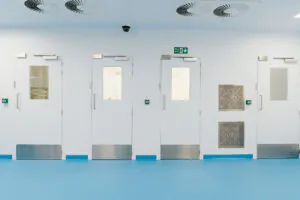
A well-considered layout usually establishes a progressive movement from lower to higher cleanliness areas. Personnel enter through appropriately designed changing rooms, while materials pass through airlocks, pass-through hatches or controlled transfer routes. The number of doors, handovers and manual actions should be kept proportionate to the process risk. Every extra movement is a potential route for contamination or procedural error.
Pressure cascades help prevent the ingress of contamination from adjacent spaces. In many aseptic applications, cleaner areas are maintained at a higher pressure than surrounding rooms. However, the correct solution depends on the product hazard. Containment suites for cytotoxic, highly potent or sensitising products may need pressure arrangements that protect operators and the wider facility. This is where a simple rule such as ‘always positive pressure’ can lead to the wrong design decision.
Airflow is equally process-specific. Terminal HEPA filtration, adequate air change rates, controlled temperature and humidity, and sensible air distribution are all required, but their values should be justified rather than copied from a generic specification. Critical Grade A zones need demonstrable protection of exposed product. Airflow visualisation studies, often called smoke studies, are used to show that air moves as intended and that interventions do not compromise first-air protection.
Finishes, furniture and services should support cleanability and reliability. Smooth, sealed surfaces; flush details; coved junctions; accessible service routes; and materials compatible with the cleaning regime all reduce contamination traps and maintenance disruption. The aim is not merely an attractive enclosure. It is a facility that can be cleaned, inspected, repaired and requalified without introducing avoidable risk.
Qualification turns design intent into evidence
GMP requires documented evidence that facilities, utilities and equipment are fit for their intended purpose. This is normally delivered through a lifecycle approach to qualification, beginning with user requirements and continuing through design, installation, operation and performance.
The user requirements specification should define the process, capacity, classifications, environmental conditions, utilities, containment needs, monitoring points and compliance obligations. From there, design qualification confirms that the proposed solution can meet those requirements. Installation qualification verifies that the system has been installed correctly, while operational qualification tests functions such as alarms, interlocks, pressure controls and recovery performance. Performance qualification then demonstrates consistent operation under representative conditions.
For cleanrooms, the verification programme commonly includes particle counting, airflow volume and velocity testing, HEPA filter integrity testing, room pressure testing, temperature and humidity mapping where relevant, airflow visualisation, and microbiological monitoring. The exact scope should be risk-based and governed by the approved validation master plan.
Using a UKAS ISO 17025-accredited
validation provider gives quality teams greater confidence in the competence, traceability and impartiality of critical test data. It also helps ensure that results are presented in a form that supports release decisions, audits and future requalification planning.
Environmental monitoring must lead to action
Environmental monitoring is not a monthly reporting exercise. It is an early-warning system that confirms ongoing control and identifies adverse trends before they become a product-quality event.
A risk-based monitoring programme should define viable and non-viable monitoring locations, sampling frequencies, alert and action limits, incubation methods, identification expectations and response procedures. Locations should reflect the process rather than the convenience of sampling. Critical zones, operator positions, transfer points and areas where airflow may be disrupted all warrant careful assessment.
Data only becomes useful when it is reviewed in context. A single excursion may be caused by an intervention, an atypical activity or a sampling issue, but it still needs investigation. Repeated low-level results below an action limit can be more revealing than an isolated failure if they show a deteriorating trend. Quality, engineering and operations teams should be able to connect monitoring results with maintenance records, cleaning activity, operator behaviour and production events.
People and procedures are part of the cleanroom system
Even the best-engineered facility can be undermined by inconsistent behaviour. Pharmaceutical operators need role-specific training in gowning, aseptic technique, material handling, cleaning, intervention control and escalation of abnormal conditions. Training should be assessed through observation and periodic reassessment, not only acknowledged through a signature.
Gowning procedures need to match the grade and the activity. Garments must be suitable for the cleanroom classification, correctly stored and managed through a controlled laundry or disposal process. For aseptic work, personnel qualification often includes microbiological gown monitoring and assessment of aseptic practices.
Cleaning and disinfection require the same discipline. The programme should define agents, concentrations, contact times, rotation, application methods and records. Sporicidal treatment may be necessary in sterile areas, but it must be compatible with facility finishes and equipment. A poorly selected disinfectant regime can damage surfaces, create residues or provide a false sense of control.
Maintaining compliance after handover
Cleanroom compliance does not end at commissioning. Filters age, seals degrade, sensors drift, process loads change and modifications can alter airflow patterns. A lifecycle service plan should cover
planned preventative maintenance, calibration, periodic testing, requalification, decontamination and controlled change management.
Any alteration to the room, HVAC system, equipment layout, monitoring arrangement or production process should be assessed before implementation. A new filling machine, an additional operator station or a changed material route may require partial requalification and updated airflow studies. Treating these changes as minor facilities work can leave a significant gap in the GMP evidence base.
For organisations planning a new facility or upgrading an existing suite, Total Clean Air can combine
cleanroom engineering with commissioning, UKAS-accredited validation and ongoing technical support. This joined-up approach gives project teams a clearer route from user requirement to validated, maintainable performance.
The most dependable pharmaceutical cleanroom is one that makes correct operation easier every day. Start with the product and process, build the controls into the facility, and retain the evidence needed to show that performance remains under control long after the handover certificate is signed.