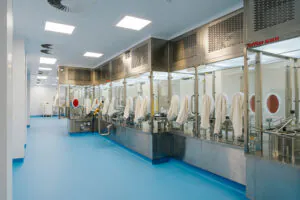
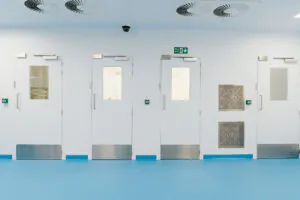


A cleanroom can look complete, operate quietly and still fail to control the conditions that matter most. Airflow may not protect a critical work zone, pressure may drift when doors are used, or recovery after an intervention may take longer than the process permits. Cleanroom validation provides the documented evidence that the facility performs as intended, under defined and representative operating conditions.
For regulated manufacturing, laboratories and technically demanding production environments, that evidence is central to product quality, patient safety, process reliability and audit confidence. It is not a final paperwork exercise after construction. It is the point at which design intent, installed systems and real operational performance are brought together and proven.
What cleanroom validation actually proves
Cleanroom validation is a structured programme of inspection, measurement, testing and reporting used to demonstrate that a controlled environment meets its specified performance requirements. The applicable requirements will depend on the facility’s purpose, classification and regulatory context. They may be drawn from ISO 14644, GMP guidance, client quality systems, sector standards and the approved user requirement specification.
The essential question is straightforward: can this cleanroom consistently maintain the environmental conditions required for the work taking place inside it? Validation turns that question into objective, traceable evidence.
For a pharmaceutical aseptic area, the focus may include particulate control, airflow direction, air change performance and pressure cascades that reduce contamination risk. In an electronics facility, electrostatic control and particulate limits may be equally significant. A healthcare laboratory may need to demonstrate appropriate containment, room recovery and environmental monitoring arrangements. The test regime should therefore be proportionate to risk, rather than a generic checklist applied to every room.
Validation starts before the room is built
The most efficient validation programmes begin at concept and design stage. If the operational requirements are unclear, later testing can only confirm whether the wrong solution has been built correctly.
A well-defined user requirement specification establishes the basis for the project. It should describe the intended processes, occupancy, equipment heat loads, material flows, cleanliness classification, pressure relationships, temperature and humidity limits, monitoring expectations and relevant standards. It must also address how the room will be cleaned, maintained and used during normal and abnormal conditions.
From there, the design can be assessed against those requirements. This stage is often described through design qualification, where project documentation, drawings, calculations and proposed equipment selections are reviewed. The purpose is to identify compliance or performance gaps while they are still practical and cost-effective to resolve.
This early discipline matters particularly when selecting between a bespoke cleanroom and a modular system. A modular format can offer rapid deployment, repeatable construction and future adaptability, but it still needs to accommodate the required HVAC strategy, service penetrations, room pressures and process layout. Bespoke construction offers greater freedom for complex interfaces and specialist workflows, although it may require a longer design and coordination period. Neither route removes the need for a clear validation strategy.
Commissioning and validation have different jobs
Commissioning and validation are closely related, but they are not interchangeable. Commissioning confirms that systems have been installed, configured and operate in accordance with the design. Validation demonstrates, through formal testing and documented acceptance criteria, that the completed facility meets its intended use.
Commissioning activities commonly include checking fan operation, controls logic, alarms, airflow volumes, temperature performance, ductwork integrity and the operation of interlocks. Defects found at this stage should be rectified before formal validation testing begins. Attempting to validate an uncommissioned system creates avoidable failures, re-testing and programme delay.
Installation qualification then confirms that equipment and systems are installed as specified, with the required records, calibration certificates, manuals, materials information and identification in place. Operational qualification tests defined functions, such as alarm responses, pressure controls and operational setpoints. Performance qualification considers the room in use or under conditions that realistically represent use.
The terminology and detail can vary between organisations and sectors. What should not vary is the logic: define the requirement, verify installation, test function and demonstrate sustained performance.
The core tests that establish controlled performance
A validation scope must be tailored to the classification and risk profile of the cleanroom. However, a number of tests regularly form the technical foundation of a cleanroom validation programme:
- Airborne particle counting establishes whether the room achieves its required ISO cleanliness classification at rest or in operation.
- Airflow velocity, volume and air change testing confirms that supply air is delivered at the intended rate and supports the designed ventilation strategy.
- HEPA filter integrity testing checks that terminal filters, housings and seals do not permit bypass leakage that could compromise air cleanliness.
- Room pressure differential testing verifies that the pressure cascade supports protection of the product, process, personnel or adjacent areas.
- Airflow visualisation, often called smoke studies, makes airflow patterns visible and can reveal turbulence, reflux or transfer routes not apparent from numerical readings alone.
- Recovery testing assesses how quickly a room returns to its specified cleanliness condition after a defined particulate challenge or disturbance.
- Temperature and relative humidity mapping demonstrates that environmental conditions remain within the required limits across the room and over an appropriate period.
Not every cleanroom requires every test at the same frequency or level of scrutiny. For example, airflow visualisation is especially valuable where unidirectional airflow protects an exposed critical process, while a general ISO-controlled assembly room may require a different evidence package. A competent validation provider will explain the rationale for the scope and identify where additional tests are warranted.
Why test conditions matter
A result only has value when the test condition is understood. A room that meets particle limits at rest may perform differently with operators, equipment, packaging and routine movement present. Conversely, testing a newly built room before cleaning, balancing and operational procedures are established can create misleading failures.
Validation protocols should state whether testing is performed at rest, in operation or under a defined simulated activity. They should identify the room state, equipment status, sampling locations, acceptance criteria, calibrated instruments and deviations process. This allows results to be interpreted properly and repeated when required.
The same principle applies to pressure testing. A static reading with all doors closed is useful, but it does not fully demonstrate how the pressure cascade responds to door opening, personnel movement or changing extract demand. Where operational risk is high, dynamic testing provides stronger assurance.
Documentation is part of the control strategy
In an audit, undocumented confidence carries little weight. The validation package should provide a clear chain from requirements through to test evidence and final acceptance. Typically, this includes approved protocols, risk assessments, instrument calibration records, raw data, test reports, deviation records, corrective actions and a validation summary.
Good documentation does more than satisfy an inspector. It gives engineering, quality and operations teams a known baseline. When a room is altered, an alarm occurs or environmental trends begin to change, the original validated condition provides a reference point for investigation and decision-making.
Traceability is particularly important where cleanrooms support GMP activities or critical medical, defence, aerospace and research processes. Test methods need to be appropriate, personnel need to be competent, and the evidence must be credible to customers, regulators and internal quality teams. UKAS ISO 17025-accredited testing provides added confidence that validation activities are delivered within an independently assessed quality framework.
Validation is not a one-off event
A cleanroom’s performance changes over time. Filters load, seals age, controls are adjusted, equipment is moved and processes evolve. A facility that was compliant at handover can gradually move away from its validated state without a disciplined lifecycle plan.
Periodic requalification verifies that critical performance remains in control. The appropriate interval depends on risk, regulation, room classification, process sensitivity, historical performance and change activity. Some environments require frequent monitoring and regular formal testing; others can justify longer intervals when supported by risk assessment and trend data.
Change control is equally important. Alterations to HVAC systems, terminal filters, room layouts, process equipment, occupancy or operating procedures may affect airflow, pressure or contamination risk. The question is not simply whether the change appears minor. It is whether it could affect a validated parameter. A documented impact assessment should determine whether partial or full revalidation is required.
Environmental monitoring complements periodic validation by providing ongoing visibility of conditions. Differential pressure, temperature, humidity and particle data can identify drift before it becomes a product-quality or compliance issue. This turns cleanroom management from reactive fault finding into planned performance control.
Choosing a validation partner
The right partner should understand both the test methods and the facility behind them. A technically correct result is only useful if it is interpreted against the process risk, applicable standards and intended operation of the room.
Look for proven experience in your sector, appropriate accreditation, calibrated equipment, clear reporting and the capability to support corrective action where results fall outside acceptance criteria. There is a commercial advantage in working with a provider that can connect design, construction, commissioning, validation and ongoing maintenance: issues can be resolved with clear accountability rather than passed between contractors.
Total Clean Air combines cleanroom delivery with UKAS ISO 17025-accredited validation and lifecycle services, helping teams move from project completion to controlled, supportable operation with confidence.
The most useful validation outcome is not simply a passed certificate. It is the assurance that your people understand the facility’s operating limits, your quality team can defend the evidence, and your cleanroom is ready to perform reliably when the process depends on it.