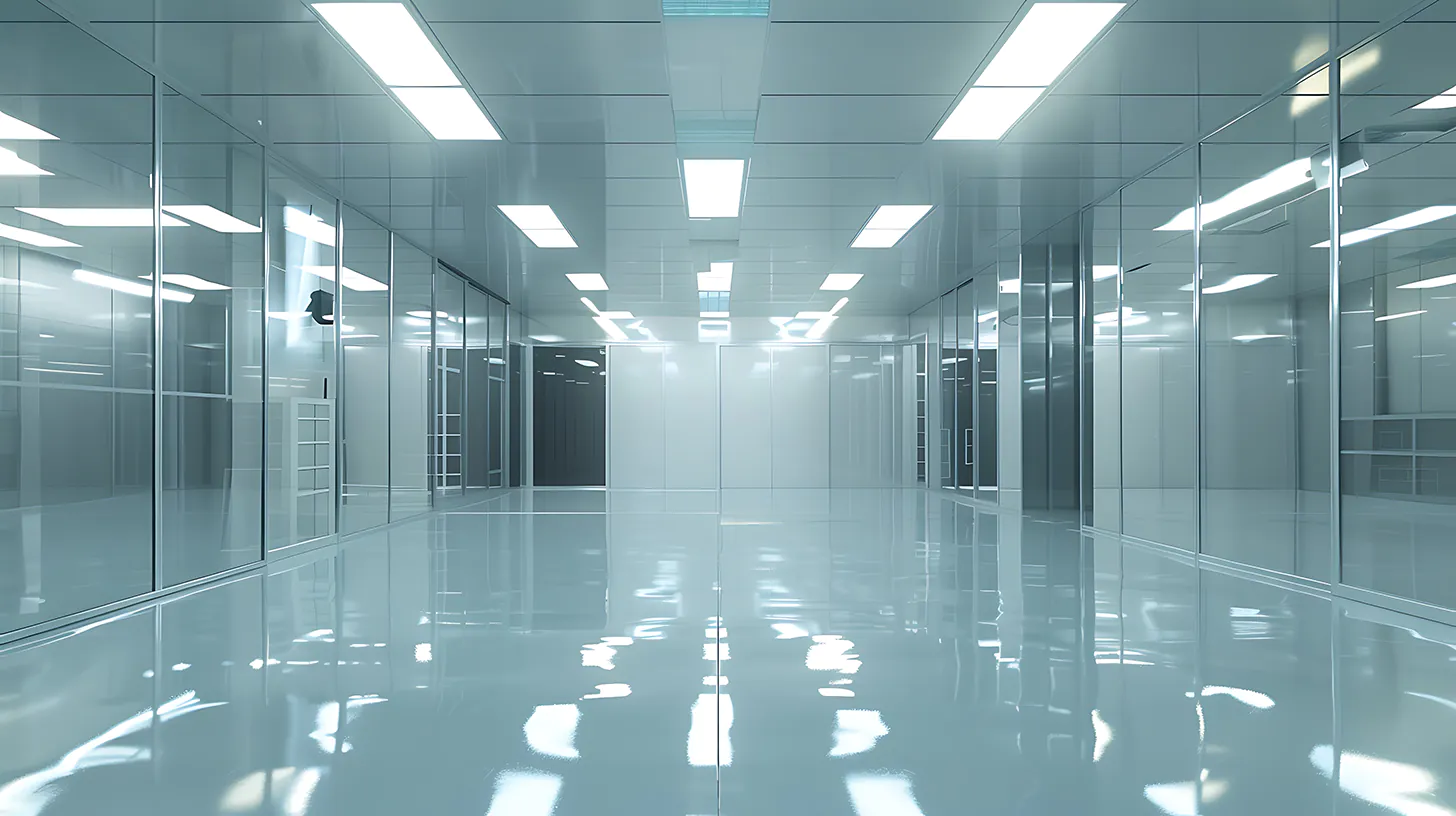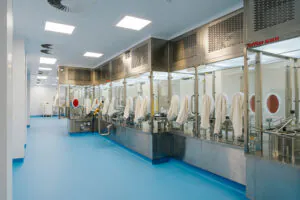


A door opens, materials enter and a short-lived particle event occurs. What matters next is not simply whether the cleanroom eventually returns to its specified classification, but how predictably and how quickly it does so. Cleanroom recovery time provides a practical measure of that response. It connects airflow design, filtration, pressure control and operational discipline to the performance that quality teams, regulators and production managers need to rely on.
For regulated facilities, recovery is not an academic figure or a commissioning formality. Slow or inconsistent recovery can reduce usable capacity, complicate investigations after excursions and expose weaknesses that are not apparent while a room is empty. A well-designed, properly maintained cleanroom should restore controlled conditions in a documented and repeatable manner.
What is cleanroom recovery time?
Cleanroom recovery time is the time taken for airborne particle concentrations to reduce from an elevated level to an agreed acceptance level after a challenge or disturbance. In practice, the starting condition may result from a controlled particle challenge during testing, routine personnel movement, materials transfer or an operational event. The target condition is usually linked to the room's intended ISO classification, GMP requirement or project-specific environmental specification.
The test is commonly associated with ISO 14644-3, which sets out test methods for cleanrooms and controlled environments. It is often performed as part of commissioning and qualification to demonstrate that the completed facility operates as designed. The result may be expressed as the time required to achieve a specified reduction in particle concentration, or as a recovery rate calculated from measured particle-decay data.
The distinction matters. A recovery result only has meaning when the test method, particle size, measurement locations, initial challenge level, airflow state and acceptance criterion are clearly defined. Comparing two recovery times without that context can produce the wrong conclusion.
Why recovery performance matters to compliance and uptime
Recovery testing provides evidence that the ventilation system is not merely delivering air, but controlling contamination effectively after a disturbance. This is particularly relevant where products, processes or investigations are sensitive to airborne particulates and where the facility must return to a controlled state between activities.
For pharmaceutical and biotechnology environments, recovery capability can support contamination-control strategy decisions, room release procedures and assessment of operational interventions. In medical-device, electronics, aerospace and advanced-manufacturing applications, it helps demonstrate that the cleanroom can protect product quality from the contamination risks created by routine access and handling.
The commercial effect is equally clear. If a cleanroom recovers quickly and consistently, teams can plan work with greater confidence. If performance is marginal, operators may need longer waiting periods, more restrictive access arrangements or additional investigation following a deviation. The most appropriate target depends on the process, classification and risk assessment. Faster is not automatically better if it is achieved with unnecessary energy use, excessive air velocities or a design that is difficult to maintain.
What affects cleanroom recovery time?
Recovery is influenced by the whole controlled environment, not one item of equipment. Air change rate is significant, but it is only one part of the engineering picture.
Airflow pattern and room geometry
The direction and uniformity of airflow determine whether airborne particles are swept efficiently towards returns or allowed to circulate through stagnant areas. Unidirectional airflow systems are generally designed to move contamination away from critical zones in a controlled path. Non-unidirectional systems rely on effective dilution and mixing, making diffuser placement, return locations, room shape and equipment layout especially important.
Obstructions can change the result. Large process equipment, storage units, benches and poorly positioned furniture may create low-velocity areas where particles remain suspended for longer. This is why recovery should be assessed in a room configuration that represents its intended use, rather than in an empty shell that bears little resemblance to day-to-day operations.
Filtration, air volume and balancing
High-efficiency filtration, sufficient supply air volume and correctly balanced extract and return paths all contribute to particle removal. A cleanroom may have appropriate HEPA filtration but still recover poorly if fan duty is inadequate, terminal units are unbalanced or air is short-circuiting between supply and return.
Pressure cascades require similar attention. Differential pressure is primarily used to manage air movement between adjacent areas, rather than to establish particle recovery within a single room. However, uncontrolled leakage, unstable pressures or badly coordinated door operation can disrupt the designed airflow pattern and affect the repeatability of results.
Occupancy and operating practices
People are often the greatest source of airborne contamination in a cleanroom. Garment selection, changing procedures, movement patterns, door openings and material-transfer methods all affect the size and nature of the particle burden introduced to the space.
A room that achieves an excellent recovery test at rest may perform differently during operation. This does not make the initial test invalid. It means the validation strategy should reflect the risks that matter to the process. Where operational recovery is critical, testing and monitoring plans should be designed around realistic conditions and documented acceptance criteria.
Condition of the installed system
Performance can change over time. Loaded filters, damaged seals, fan degradation, control faults, altered layouts and unapproved modifications can all affect airflow and recovery. A result obtained at handover is valuable, but it is not a lifetime guarantee. Planned preventative maintenance, periodic requalification and environmental monitoring protect the original investment and provide early warning before a minor drift becomes a production issue.
How recovery testing should be planned
A credible recovery test begins before particle counters are placed in the room. The protocol should establish the room state, the particle sizes to be measured, the initial and final concentrations, sample locations, sampling intervals, test duration and acceptance criteria. It should also identify whether the test is undertaken at rest, in an agreed operational state or after a defined challenge.
The challenge method needs careful control. Artificially generating a particle concentration can make decay easier to observe, but the approach must be suitable for the facility and must not introduce contamination risks of its own. In some settings, natural recovery following an agreed disturbance is more representative. The right approach depends on the applicable standards, product risk and the purpose of the test.
Measurement locations should reflect risk, not convenience. Testing only close to supply diffusers may create a favourable result while missing a poorly performing area behind equipment or near a transfer route. A competent validation provider will review airflow visualisation, room layout, critical work zones and previous monitoring trends when defining the sampling plan.
Recovery calculations should be transparent and traceable. Where a rate is calculated, the report should show the raw data, timing, particle size channel and calculation method alongside the final conclusion. This allows quality teams and auditors to understand what has been demonstrated and to assess any limitations without relying on an unexplained pass statement.
Designing for dependable recovery
The most reliable results are designed into the project at concept stage. Cleanroom classification, process flow, occupancy, heat loads, equipment footprint and maintenance access all influence the ventilation solution. Leaving recovery requirements until late-stage validation can lead to costly remedial work, particularly where ductwork, terminal filtration or return-air routes are difficult to alter after installation.
A practical design review should consider the required cleanroom class, critical zones, expected door activity, material routes, pressure regime and the future flexibility of the space. Modular systems can offer a sensible route where a facility needs rapid deployment or later expansion, but they still require disciplined engineering of airflow, interfaces and controls. Bespoke facilities may be appropriate where process equipment and building constraints demand a tailored approach.
Commissioning then verifies that the installed systems perform as intended. Airflow volumes, air velocities, filter integrity, pressure differentials, temperature, humidity and airflow direction should be evaluated as a coordinated set of conditions. Recovery testing is strongest when it sits within this wider evidence base, supported by calibrated instruments and documented test procedures.
For facilities requiring independent assurance, UKAS ISO 17025-accredited validation provides added confidence that testing is performed to an accredited scope, using controlled methods and traceable measurement practices. That assurance is valuable when demonstrating compliance to customers, notified bodies, auditors and internal quality teams.
When a recovery result needs investigation
A failed or deteriorating recovery result should not automatically be attributed to insufficient air changes. The investigation should start with the test conditions. Confirm that the room configuration, challenge level, counters, sampling positions and HVAC operating state match the approved protocol. A changed test method can appear to create a performance issue where none exists.
If the result is confirmed, airflow visualisation can reveal whether the cause is poor distribution, recirculation or local obstruction. Filter integrity testing, air-volume measurement and control-system checks can then identify faults in filtration, fan performance or balancing. Reviewing recent changes is equally useful: new equipment, revised furniture layouts, altered door practices and maintenance works are common contributors.
The right corrective action may be as straightforward as rebalancing air volumes or repositioning a workstation. In other cases, the room may require additional returns, revised terminal placement, upgraded fan capacity or changes to operational procedures. The aim is not to chase a single number, but to restore repeatable contamination control that remains appropriate for the process.
Total Clean Air approaches recovery as part of a cleanroom's complete performance picture, from early design decisions through commissioning, UKAS-accredited validation and lifecycle maintenance. The strongest assurance comes when the facility, the test method and the way people use the space are aligned. That is how recovery performance becomes a dependable part of everyday compliance, rather than a result that only looks good at handover.